
This post contains an affiliate link. We may earn a commission at no extra cost to you. Learn more
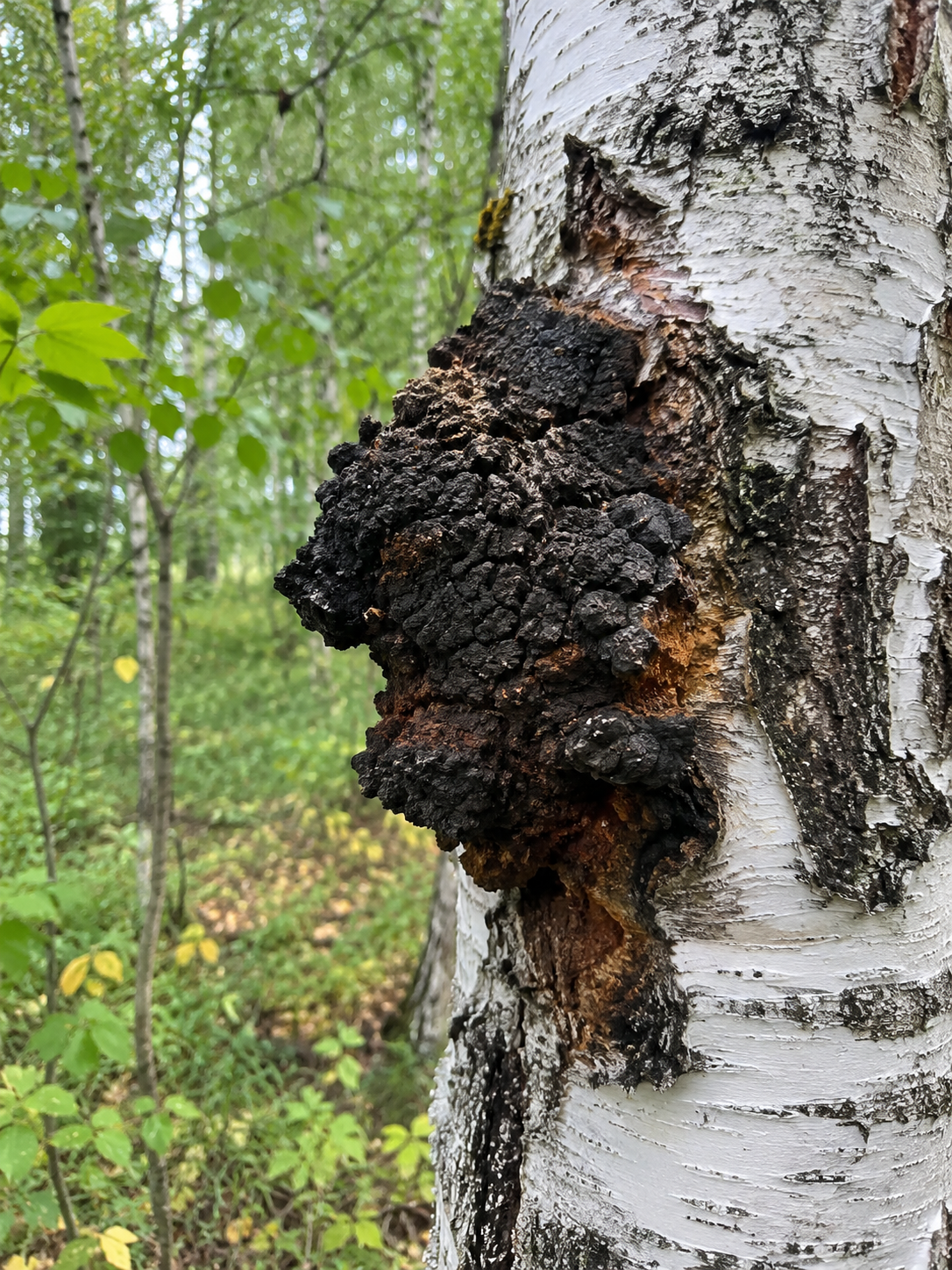
Chaga looks like a hard, black, cracked lump that resembles burnt charcoal, growing on the side of a living birch tree. When you break off a piece, the inside is rusty orange to yellow-brown and feels a bit like cork. It is not a cap-and-stem mushroom, and it is not psychedelic. It is a sterile conk of a fungus called Inonotus obliquus.
Quick Facts
- Outside: Black, deeply cracked, charcoal-like
- Inside: Rusty orange to yellow-brown, cork-like
- Grows on: Living birch in cold northern forests
- Type: A sterile conk, not a cap-and-stem mushroom
- Psychedelic?: No. Chaga has no psilocybin
- Best harvest time: Fall and winter, before the sap runs
- Golden rule: Only take what you can identify with certainty
Table of Contents
ToggleWhat Does Chaga Look Like?
Most people expect a mushroom with a cap and a stem. Chaga looks nothing like that. It is a dense, woody mass that sticks out of a tree trunk, and it is easy to mistake for a burn scar or a lump of bark.
The outside
The outside is black and deeply cracked, with a rough, warty texture, like burnt charcoal. Mycology groups describe it as a black, deeply cracked conk with a charred look. It can be brittle, and small pieces may break off.
The inside
Chip off a small piece and you will see a yellow to rusty-brown inside, sometimes with tiny white flecks. It feels soft and corky next to the hard crust. This color check is the fastest way to tell chaga from many look-alikes.

Size and shape
Chaga ranges from a small knot to a lump as big as a human head. It has no set shape, and it sticks out of the trunk instead of lying flat.
Young vs. mature chaga
A young conk starts as a small, dark, flaky patch on the bark. As it ages, it grows larger and hardens into a thick black crust with deep cracks. One forager guide cites a study that put its growth at about one centimeter a year, so a big conk is decades in the making.
Is Chaga Psychedelic?
Will chaga show up on a drug test? Chaga is not a controlled substance, and routine drug panels test for specific drugs, not for mushrooms like chaga. If your employer or doctor orders a particular test, ask them directly.
Which Trees Does Chaga Grow On?
Chaga is a parasite that grows mostly on birch. In North America, it shows up most often on paper birch (Betula papyrifera) and yellow birch (Betula alleghaniensis). Bigger, well-developed conks tend to grow on older trees, often more than 40 years old.
Sources disagree about other trees. University of Minnesota Extension also lists aspen, alder, and elm, and some guides mention oak, maple, and ash. These are rare, and beginners should treat any non-birch host as a warning sign. If it is not on a birch, stop and double-check before you take anything.
Where Do You Find Chaga?
Chaga grows in cold northern forests: northern Europe and Asia, Canada, the northeastern United States, and Alaska. It is rare in warm southern states, so if you live in the South you are unlikely to find wild chaga nearby.
- Look in mature birch stands, often in cool, damp woods and near water.
- Scout in summer, when leaves make the tree easy to name, then return in winter to harvest.
- Chaga lasts all year, and it is easiest to spot once the leaves drop. UMN Extension notes it stands out in winter.
Wild chaga from Alaska is common in stores. The bag of Arctic Chaga Ground, for example, is labeled wildcrafted Alaska chaga.
Look-Alikes
A mycology society lists no poisonous look-alikes for chaga. Still, other growths can fool you, and none of them is chaga. Do not use anything you are not sure about.
|
Look-alike
|
How it differs from chaga
|
|---|---|
|
Black knot fungus
|
Usually smaller and more evenly shaped, with a harder texture and no orange inside
|
|
Tree burl
|
A round lump of tree wood. The inside is hard, pale, and woody, not orange
|
|
Tinder or false tinder fungus
|
Bracket fungi with a different, often softer or crumbly outside and a visible shelf shape
|
|
Burnt or scarred bark
|
Flat and part of the bark, with no lump sticking out
|

How to Check It Is Chaga
- Check the tree. It must be a living birch. Look at the bark and leaves, or the buds in winter.
- Check the outside. It should be black, cracked, and charcoal-like.
- Check the inside. Chip a small piece. It should be rusty orange to yellow-brown and corky, not hard, white, and woody.
- Check the shape. It should stick out of the trunk as an irregular mass.
- If any step fails, leave it. A good guide beats a guess.
When in doubt, take a photo and ask a local mycological society. Many clubs help beginners for free.
How to Harvest Chaga
- Time of year: fall and winter. Stop when the birch sap starts to run in spring.
- Living trees only. Chaga on dead birch has already begun to rot.
- Take big ones only. Many guides say to harvest only conks larger than a grapefruit and leave small ones to grow.
- Leave a share on the tree. Guides range from leaving 15 to 20 percent up to a third or half. Leaving more is the safer choice.
- Do not cut into the tree. Chip the conk away and never hack into the bark.
- Take only what you will use. A conk grows slowly, and forests do not have an endless supply.
- Skip moldy, buggy, or roadside chaga.

Does harvesting hurt the tree? Views differ. UMN Extension says removing a conk does not harm a tree that is already dying, while other guides stress living trees and a protected share. Chipping only the conk and leaving the bark alone avoids most harm. I have not harvested chaga myself, so this advice comes from the sources below. If you are new, go with an experienced forager the first time.
How Long Does Chaga Last on a Tree?
A conk keeps growing as long as the birch lives, and estimates for that vary a lot. Research in Finland puts the time to a harvestable conk at about five to ten years. UMN Extension says a harvested conk can take up to 20 years to regrow to its old size. One forager guide says a conk can live from about 10 to over 80 years. Because it is so slow, taking only part of a conk matters.
Is It Legal to Harvest Chaga?
It depends on the land and the country, so check before you go. National forests, state parks, and private land each have their own rules. Minnesota is one example: state forest rules allow small amounts of mushrooms for personal use without a permit but require one to cut or remove trees or plants, and a conk is part of a tree. Parks often ban collecting entirely.
- Ask the land manager (Forest Service, BLM, state office) what applies to chaga.
- Get written permission from private landowners. Never take chaga from someone’s land without it.
- Do not assume. Rules for mushrooms may not cover a conk that grows from a tree.
Wild vs. Cultivated Chaga
Wild chaga is the black conk, the part this guide describes, harvested from a living birch. Many products labeled “cultivated chaga” are actually mycelium grown on grain or in liquid, and sources say that is not the same material as the conk. Check the label for what you are buying.
Can you grow chaga at home? Not like other mushrooms. Chaga needs a living birch, so you cannot grow it in a bag or a grow room. In Finland, researchers inoculate living birch by drilling holes and inserting dowels filled with chaga mycelium, much like plug spawn for a log. The wait before the first harvest is about five to ten years.
Storing Chaga: Does It Go Bad?
Yes, it can. Chaga that stays damp can grow mold, so dry it first. Sources disagree on shelf life. Some say properly dried chaga lasts up to five years, while others say one to two. Store it in a cool, dry, dark spot with good airflow, and throw it out if you see mold or smell mustiness. If you cannot dry it right away, one forager guide suggests freezing it, while UMN Extension says you do not need to refrigerate or dehydrate it if you keep it dry.
How Much Does Chaga Cost?
Prices swing a lot, and they change over time. At the time of writing, dried chunks often sell for roughly $25 to $75 per pound, and fresh Maine chaga was listed near $30 per pound. Processed products cost more: a 4 oz bag of Arctic Chaga chunks was $25, and an 8 oz box from another seller was $50, which works out to about $100 per pound. Price depends on how dry it is, where it came from, and how it is cut.
Prefer Not to Forage?
Finding the right birch, identifying chaga, and getting permission is a lot of work. If you would rather skip it, you can buy chaga that someone else harvested. Arctic Chaga sells wildcrafted Alaska chaga, including the Chaga Ground I use in my drinks. Read the label, and learn how to prepare it in our guide to making chaga tea.

Exclusive Reader Discount - Save $10!
Want a ready-made chagaccino without measuring powder every morning? A pre-blended chaga coffee skips the extra step
Apply Code: LEARNMUSHROOM
This post contains affiliate links. I may earn a commission at no extra cost to you.
Quick Answers on Chaga and Health
These questions come up a lot. I do not make health claims, so here are short answers and where to read more:
|
Question
|
Short answer
|
|---|---|
|
What does chaga do to your body or brain?
|
|
|
Does chaga give you a buzz?
|
|
|
Is chaga hard on the liver?
|
I did not find reliable evidence of liver harm. Documented concerns are kidney problems and drug interactions.
|
|
Who should avoid chaga, and what not to mix with it?
|
Check with a doctor first if you take blood thinners or diabetes medicine, have kidney issues, or are pregnant or nursing.
|
|
Is it safe to drink every day?
|
Frequently Asked Questions
Q1: What does chaga look like?
Q2: How do you know if you have chaga?
Q3: What tree does chaga grow on?
Q4: What time of year do you harvest chaga?
Q5: Does chaga grow in the South?
Q6: Can you grow chaga at home?
Q7: Is chaga related to Chagas disease?
Q8: Is chaga a psychedelic mushroom?
Key Takeaways
- Chaga is black and cracked outside, with a rusty orange, corky inside
- It is not psychedelic. It has no psilocybin
- It grows on living birch, mostly paper and yellow birch, in cold northern forests
- Check the tree, the outside, and the inside before you trust an ID
- Harvest in fall and winter, take big conks only, and leave a share on the tree
- Check the land rules first, and get written permission on private land
Want more? Browse our mushroom species guide.
Sources
- Inonotus obliquus — Midwest Mycology, description and look-alikes
- Inonotus obliquus — Wikipedia, host trees and sterile conk
- Chaga Identification — Edible Wild Food, habitat and tree age
- Chaga: a delicious find in the winter woods — University of Minnesota Extension
- Harvesting on state forest lands — Minnesota DNR, example of public-land rules
- How to Forage, Preserve, and Use Chaga — North Spore, growth rate and storage
- Foraging and Harvesting Chaga Sustainably — Grow Forage Cook Ferment
- How to Harvest Chaga — Chaga Insight, season and sap
- Chaga: a possible superfood from Finland forests — UPM, Natural Resources Institute Finland trial
- As Chaga Keeps Trending, Mycologists Worry About Running Out — Modern Farmer
- Preserve and store chaga so it lasts for years — Bangor Daily News
